David J. Toscano

Attorney at Law

  • Home
  • Collaborative Law
    • Principles Of Collaborative Divorce Practice
    • Sample Collaborative Participation Agreement
  • Estate Planning
  • Contact David
  • Submit a Payment
  • Terms & Conditions

Follow-up to Arts Celebration on July 21

July 28, 2016 by David Toscano

In Case You Missed It —

A number of attendees requested copies of the remarks I made at our Annual Celebration of the Arts event at Light House Studio last week. They are printed below. I hope you enjoy.

“Thank you all for attending our annual fundraising event in celebration of the arts in our community. It is an honor that, in the midst of a presidential campaign, where so much is at stake, so many of you would come out to support our efforts to change the House of Delegates.

Thank you to Light House for all the wonderful work that you have done over the years to bring the magic of film, digital, and media production to so many young people in our community. And thank you especially for what you, your board, and your supporters, have done to bring this wonderful Vinegar Hill Theatre back to life. For so many years, this theater was an artistic hub of Charlottesville. I remember watching so many films here, from the political such as Michael Moore’s ‘Fahrenheit 451’ to Al Gore’s ‘An Inconvenient Truth’ to cutting edge dramas and independent offerings. We are hopeful that the Vinegar Hill vibes will rub off on Light House for many years to come.

I think it was John F. Kennedy who said, ‘The arts reflect the creativity and talent of a free people.’ This statement reflects the view that the arts are not some idle pastime and indulgence for the well-to-­do, but are at the core of what makes a great society. The arts are one way in which we distinguish ourselves as free. The arts challenge us to innovate, cultivate talents in all professions, and help explain a world that is increasingly complex. The arts help us to see things differently and to grow as individuals, communities and societies. Not only do the arts provide us with a different view of the world around us, but more importantly the arts help us change our world in a positive way. And isn’t that what a lot of us want – to make our communities richer and more fulfilling for all of our residents? Life is much more than just about us – it is about the broader community and society. That is one reason that I do these events each year. You may recall that we have had similar events at The Bridge PAI, Chroma Projects, The Paramount, and Live Arts. For each event, we have celebrated a different element of our dynamic Charlottesville arts scene – music, the visual arts, and dance. This year, it is film.

In Charlottesville, the arts are everywhere. We have McGuffey, Live Arts, Heritage, Ash Lawn Opera, PCA, Second Street, New City Arts, Look3, The Paramount, Tom Tom; the list goes on and on. It is part of what makes Charlottesville so special. And when you think about special, did you know:

  1. The Charlottesville High School Orchestra continues to win accolades around the country and around the globe, and is now planning for their fifth European trip — to Ireland — next year. Congrats to Laura Mulligan Thomas and your talented musicians. Did you know Boyd Tinsley of the Dave Matthews Band is an alumnus?
  2. Did you know that we have several Academy Award winners living in and around Charlottesville? Paul Wagner is with us tonight and you all know Sissy Spacek. In addition to the Academy Award winners, we have nominees such as Jack Fisk for his recent work on ‘The Revenant.’ We also have Emmy award winner Hugh Wilson, remembered for ‘WKRP in Cincinnati’ fame, who lives in Keswick.
  3. Did you know that films made in Virginia, including ‘Cold Mountain’ and ‘Argo,’ won Academy Awards for Best Pictures? Why ‘Lincoln,’ which was filmed in Richmond and partly in my office in the Capitol, never won is anyone’s guess.
  4. Did you know our various arts festivals continue to grow in size and stature each year? Remember that little film festival that was begun at the University of Virginia in 1988 on a shoestring budget? Yes, the Virginia Festival of Film – and its Director, Jody Kielbasa, is here tonight – now brings over 32,000 participants each year to Charlottesville for a thorough exploration of film.

A couple of weeks ago I was involved in an interesting discussion about what moves people to take action or to change their way of thinking. Is it words, as in reading a book or a poem? Or images, as in looking at a painting or photo? I am an elected official and a lawyer. I give speeches, write articles, and argue – all with words. I live in a world of words. I believe in the power of words and rational persuasion. And yet, is there anything more powerful than when you can link the words on a page or which are spoken to images? That is what film and media are all about. All of you can remember experiences that you have had with film, where the words being spoken are being combined with the images to produce a powerful outcome. Think, for example, about ‘Schindler’s List.’ How many articles have we read about the Holocaust, but for many, it never became truly real until you were able to combine  the words with the powerful images that Spielberg created on the screen, forever changing the way people thought about that horrible part of world history. The same can be said of so many films. ‘Roots’ dramatically changed our view of race relations; ‘Apocalypse Now’ and ‘Platoon’ altered our view of the Vietnam War. There is something so powerful about images that get people to see issues in a different light – or through a different lens.

So, as we celebrate the arts tonight in our community, let us also think about what we want our communities to be, and how we mobilize the best arguments to get us there. We sometimes think that this can only be accomplished through elections, and I would be the first to say that elections are critically important. But we should not forget these other ways of affecting communities around us, and should encourage those who are trying to build change in so many different ways.

Thank you for attending tonight, and I look forward to working with you to make our locality and state a better place to live.”

Videos

After this talk, short films produced by youngsters in our community were shown. Each of them is about five minutes long and can be viewed here:

SMART

Lemonade Standoff

Following that, we also showed a vignette from a 2009 White House event involving Lin-Manuel Miranda, then a relatively new talent who was describing to President and Ms. Obama a little “rap” that he was developing about one of our founding fathers, Alexander Hamilton. This “rap” ended up being the smash Broadway hit, “Hamilton.” You can view that clip here and it will only inspire you to get tickets to the Broadway performance.

There are still chances to donate to this event. Click the button below to contribute to my efforts to bring more balance to the House of Delegates and Celebrate the Arts in our Community. Part of the proceeds will go to Light House Studio.
Filed Under: Events

Celebrate the Arts in Our Community

July 8, 2016 by David Toscano

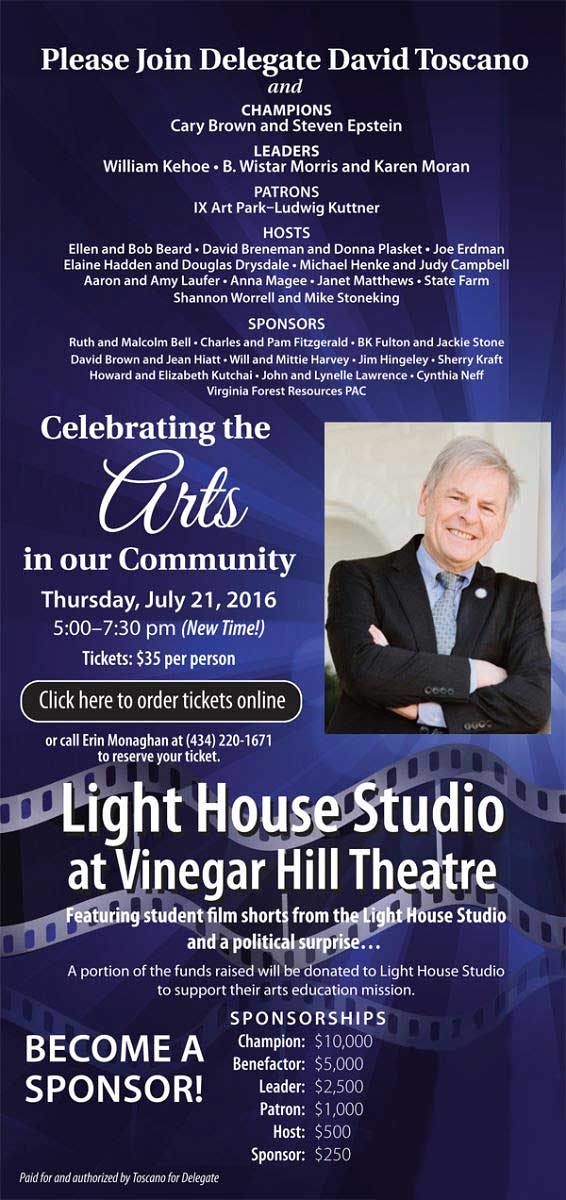
Please join us on July 21 for an event at the Light House Studio at Vinegar Hill Theatre.

Please join Delegate David Toscano for a celebration of the arts in the greater Charlottesville community

For more information about sponsorship opportunities or ticket information, contact Erin Monaghan at erin@davidtoscano.com or call 434-220-1671

Filed Under: Events

An Open Letter to Democrats in the U.S. House of Representatives

June 27, 2016 by David Toscano

Dear Friends and Colleagues:

As the Democratic Leader, and member of the minority party, in the Virginia House of Delegates, I know how you feel. While our Commonwealth has elected Democrats in all five of the statewide elected posts, Republican control of the redistricting process has given them a super majority in our House of Delegates. In Virginia, we have experienced how the Rules operate to prevent even the most popular public initiatives from getting to the floor. Virginia House Democrats have proposed a variety of common sense gun safety initiatives in the last 10 years, only to see them die in small subcommittees of five persons or less, often without any recorded vote. We have railed against Republican-sponsored initiatives that repealed Virginia’s “one-handgun-a-month” law and allowed guns in bars. We have fought initiatives that would allow guns in airports and guns in schools. And all of this has taken place in the context of our major gun tragedy at Virginia Tech, which, until Orlando, was the largest mass shooting of its type in American history, and the public execution of television reporter, Allison Parker, and her colleague, Adam Ward, on live television in August 2015.

Like you, we have participated in our “moments of silence” and expressed our sympathies for the victims of gun violence. Like you, we have prayed for the victims and their families. And like you, increasing numbers of us are now saying, “Our thoughts and prayers are no longer enough.” Like the American public, we are asking, “What will it take, and when will we act?”

With your courageous action, you have brought attention to this issue in a way that few of us would have thought possible. Like you, we are mindful of the rules, procedures, and history of our legislative bodies. Virginia is proud of asserting its claim to be the longest consecutively operated Democratic legislative body in the Western Hemisphere and we, therefore, respect institutional procedures. It is for that reason that we understand, more than most, the significance of your actions and why you have departed from established procedures.

Your efforts bring to mind the sentiments expressed by Dr. Martin Luther King’s famous “Letter from a Birmingham Jail.” You undoubtedly recall that King addressed his letter to his fellow clergymen who had expressed concern about the tactics of the civil rights movement in confronting racism. In Dr. King’s letter, which includes the often quoted phrase “injustice anywhere is a threat to justice everywhere,” he challenges his colleagues and our citizens to embrace the “tension in society” created by protest “so that individuals could rise from the bondage of myth and half truths to the unfettered realm of creative analysis and objective appraisal (in order that we might) rise…to the majestic heights of understanding and brotherhood.”

This is what you are seeking to do – create a tension and insist that the voices of the majority are heard. And those voices speak loudly and clearly for common sense gun safety measures.

In the days and weeks to come, you will continue to hear the drumbeat of those who would seek to do nothing. They will wrap themselves in the blanket of the 2nd Amendment, failing to recognize that the rights set forth therein, as are the rights of the other amendments, are not unfettered; our right to free speech does not allow us to cry “fire” in a crowded theater and most realize that prohibitions against individuals owning bazookas and surface-to-air missiles are reasonable restrictions to the right to bear arms. You will be criticized for violating rules over which you have no control. You will be accused of participating in a “political stunt.” But with all of this criticism, I hope that you will continue to stand strongly and firmly for our great American tradition of political protest and our assertion that the will of the majority ought to be recognized and realized in promoting common sense gun safety measures in this country.

I speak for many Virginians in saying we are ready to help and to make the change necessary to help our country become a safer place.

Sincerely,

David Toscano

Filed Under: General Assembly 2016 Tagged With: Gun Safety

Why States Matter

June 10, 2016 by David Toscano

Virginia is One Election Away from Becoming North Carolina

Many Virginia citizens are actively engaged in the 2016 presidential race and Congressional races down-ticket from the Clinton/Trump contest. But as we focus intensely on the national races, we should not ignore the state gubernatorial and legislative races, including those which will occur in Virginia next year.

The conservative movement in this country recognized a long time ago what many of us who seek common-sense solutions to everyday problems in an atmosphere of civility and genuine political exchange have neglected at our peril, and that is that states matter!

The statistics clearly bear this out. According to the Pew Research Center, Republicans have been very successful in electing their candidates to state legislatures in the last decade. The GOP gained 721 state legislative seats in 2010 and has continued to build their margins in the succeeding years. In 2009, Republicans controlled both legislative chambers in 14 states; by 2015, they had 30. They now control 70 of 99 legislative chambers. The Republican State Leadership Committee (RSLC) is committed to spending in excess of $100 million to expand their margins.

Our Southern Neighbor

Where Republicans have taken over, the results have been dramatic. Witness our close neighbor, North Carolina. In 2008, the state chose Obama for president, but by 2011, both the House and the Senate in the state had flipped to Republican control. With Republicans in control of redistricting, they drew new lines that further solidified their election victories, and began their “conservative revolution.” In August 2012, North Carolina banned the state from basing coastal policies on scientific predictions of sea level rise. A Republican governor was elected in 2012 and the state took a dramatic turn to the right.

In February 2013, North Carolina cut maximum weekly unemployment benefits by 40 percent, from $530 per week to $350 per week, and shortened the period of time when workers could receive the benefits, at a time when North Carolina’s unemployment levels were approaching 10 percent.

Under the guise of “tax reform,” the state imposed a greater tax burden on the middle class. It repealed “teacher tenure” for any teacher hired after July 2013, invested more taxpayer dollars in “private school vouchers,” and repealed many of the measures previous legislatures had passed to increase voter participation throughout the state.

In 2015, North Carolina reduced a fine on Duke Energy from $25 million to $7 million in the aftermath of 40,000 tons of toxic coal ash and 27 million gallons of wastewater being spilled into the Dan River from the company’s defunct coal plant. In 2015, the legislature abolished a wildly successful solar investment tax credit, which had generated substantial revenue for the state and created thousands of jobs. The legislature and Governor approved the termination of the state’s Earned Income Tax Credit, a program hailed by Ronald Reagan as the most effective anti-poverty program that we have in this country. Almost one million low-income North Carolinians were affected. The president of the University of North Carolina was ousted and replaced by a former Bush appointee, Margaret Spellings.

Then, in late March 2016, the conservative turn became national news when, in a Special Session that took less than 12 hours, the state passed a bill that not only prevented localities from enacting anti-LGBT discrimination measures, but made it more difficult for any person to enforce claims of discrimination in state courts. The publicity from its so-called “bathroom bill” has generated protests around the nation and has prompted many businesses to stop expansion plans in the state or consider relocating.

While our state elections are another 17 months away, the actions of our neighbor to the south show what can happen in the absence of the checks and balances of divided government. And we are not even talking about the next regular redistricting process, which will occur under the scrutiny, and potential veto, of the next governor. Clearly, a lot is at stake.

The “Virginia Way”

In Virginia, we celebrate the so-called “Virginia Way.” The Virginia Way implies a civil approach that embraces moderate changes focusing on core services of government and supporting a good business climate. For years, Virginia had “divided government;” Democrats and Republicans each controlled either the House, Senate, or Governorship.  In addition, there was a group of moderate Republican Senators who would stop some of the most socially regressive legislation passed by the Virginia House of Delegates from ever getting to the Governor’s desk. Unfortunately, most of those moderates are now gone from the Virginia Senate and all that stands between Virginia and North Carolina is a Governor who is willing to exercise his or her veto pen in the service of moderation. If you look at the vetoes in Virginia’s last General Assembly session, you can see this in full force. The Governor successfully vetoed efforts by the Republicans to defund Planned Parenthood, prevent the state from producing a state-initiated clean power plan, allow discrimination under the guise of religious freedom, continue inefficient and special tax benefits for coal companies and utilities, and place further restrictions on Virginians’ ability to register and vote.

Our ability to influence state races is dramatically affected by voter turnout. Although it is unlikely that voter participation in the presidential race will reach the historic levels of the 2008 Obama campaign, the percentage of registered voters who will make it to the polls this fall is likely to exceed 70 percent. Contrast that to the last Virginia gubernatorial race when only 43 percent of registered voters appeared at the polls, and state delegate races which often produce participation numbers even lower (under 30 percent in 2015).

Virginia’s Elections Matter

So as we rightfully focus on the Presidential election, we should not lose track that in Virginia we could be only one election away from our state adopting the politics of North Carolina and producing a new redistricting plan that will put the checks and balances of divided government at further risk for the next decade. The stakes could not be higher.

Filed Under: General Assembly 2016, Politics, Why States Matter

Restoration of Rights Executive Order

May 9, 2016 by David Toscano

Governor Moves to Restore Voting Rights
Republicans Resist

On April 22, 2016, Gov. McAuliffe issued an Executive Order restoring the right to vote to approximately 206,000 citizens who had been convicted of a felony in the past, had served their prison time and completed the terms of their probation. The restoration order applies to citizens who were convicted of a wide variety of offenses, from larceny in excess of $200 to certain driving offenses to robbery and more serious felonies. (Citizens who have their voting rights restored still have a felony conviction record and must still pay their fines and costs; they have not been pardoned or given clemency.)

Many have applauded his action and others have opposed it. For me, the issue revolves around two questions. First, does the governor have the constitutional authority to do this? And, second, is it good social policy to do so? Republicans in the General Assembly immediately challenged the governor’s actions, saying that he lacked constitutional authority to do it, and now are threatening to file suit to block the restorations. Beyond the constitutional issues, some criticism has focused on restoring rights to violent felons, even though they represent a relatively small number compared to the more than 200,000 who had their rights restored.

Restoration of Rights in Virginia

Restoration of rights is widely recognized as a good idea. In thirty-eight other states, the right to vote is generally restored almost automatically following a felon’s release from incarceration and parole.  Recent Virginia governors, both Democratic and Republican, have worked to restore the rights of Virginia citizens who had been convicted of a felony, served their time and completed their probation. Governor Warner was able to restore the rights of 3,486 individuals during his term, Governor Kaine restored another 4,402, and Governor McDonnell pushed even harder, restoring the voting rights of 8,111 Virginia citizens.   These governors, as well as substantial numbers of Virginians, believe that when a person has served their time, they should regain the ability to vote. McAuliffe’s action accelerated the restoration process dramatically.

Virginia is one of the most restrictive states in the country in terms of restoring voter rights. Before Governor McAuliffe’s Executive Order, Virginia had been unique in its requirement that individuals file individual petitions requesting the governor to act. This process is costly and cumbersome, and inhibits restoration.

There is a long and unfortunate history in Virginia of using the law and the Constitution to prohibit groups of people from voting, targeted primarily at African-Americans following the Civil War and into the 20th century. In fact, the Virginia Constitution of 1902 included provisions on felony disenfranchisement and other voting measures that one prominent legislator commented were designed to eliminate “every negro voter who can be gotten rid of, legally, without materially impairing the numerical strength of the white electorate.”

To address the lengthiness of the process, proponents of restoration have offered a number of solutions, from a constitutional amendment that would grant automatic restoration to various bills in the General Assembly. All of these efforts have been blocked by conservative Republicans who have systematically been increasing barriers to discourage citizens from voting. We have seen a wide variety of initiatives over the last few years designed to make it more difficult for voters to cast their ballot. And in the budget just passed by the General Assembly, Republicans eliminated monies to fund additional positions designed to assist applicants for voting rights restoration. In the face of this resistance, Governor McAuliffe decided to act. But does he have the constitutional authority to do so?

Executive Authority in Virginia

Assessing the legal argument requires us to look first at the actual language of the Virginia Constitution. Article V, Section 12, states that the power to “remove political disabilities…” (restore rights) is vested solely in the Governor. The Virginia Constitution does not limit this sweeping power. Article II, Section 1, provides that “no person who has been convicted of a felony shall be qualified to vote unless his civil rights have been restored by the Governor or other appropriate authority.” Nothing in the Governor’s Order undoes this provision of the Virginia Constitution; today, anyone convicted of a felony still loses their right to vote. The only way that right can be restored is by the action of the Governor or another appropriate authority.

The Republicans have reportedly decided to file a lawsuit challenging the governor’s constitutional authority to issue this sweeping restoration of voting rights. Many attorneys, myself included, are doubtful that this will succeed, and do not support the use of taxpayer dollars in any lawsuit contesting the Governor’s Executive Order. To date, Republicans have spent just under $100,000 of taxpayer money defending passage of a voter ID law which makes voting harder for some Virginians, and the case is not yet concluded. This is in addition to over $3.5 million of taxpayer money spent defending three redistricting lawsuits that would make state and federal districts more competitive. While Republican leaders have said that they will not use taxpayer money to fund a lawsuit against the Governor’s executive order, there is no guarantee this will not change once they have discussed the matter fully with their attorneys.

Social Policy

We are a society that values redemption and second chances. When people have served their time in prison as dictated by the justice system, they are released from incarceration and we should want to see them restored to a productive life. We want them to be able to get a job, support their families, and be involved in their communities in a positive way. Many of these individuals want to find a way to contribute to society and work for a better future. Restoring their right to vote is one way that we can help them do that. Will they register – and will they vote? Only time will tell. But Governor McAuliffe has certainly given them the opportunity once again.

P.S. – If citizens want to register to vote, they can do so online at www.elections.virginia.gov, or go to their local Registrar’s office. If you have a felony conviction, and you want to know if you are eligible to re-register to vote, you can go to www.commonwealth.virginia.gov/ror.

Filed Under: General Assembly 2016 Tagged With: Voting Access

  • « Previous Page
  • 1
  • …
  • 29
  • 30
  • 31
  • 32
  • 33
  • …
  • 62
  • Next Page »

Contact Me

123 E. Main Street
8th Floor
Charlottesville, VA 22902
Email: davidjtoscano@gmail.com
Phone: 434-960-7171

Mailing Address

P.O. Box 501
Charlottesville, VA 22902

Make a Payment

Authorized by David J. Toscano, Attorney
© Copyright 2025 · DavidToscano.com · All Rights Reserved ·